


Contextual SEO vs Keyword SEO: Which Strategy Builds Long-Term Organic Growth?
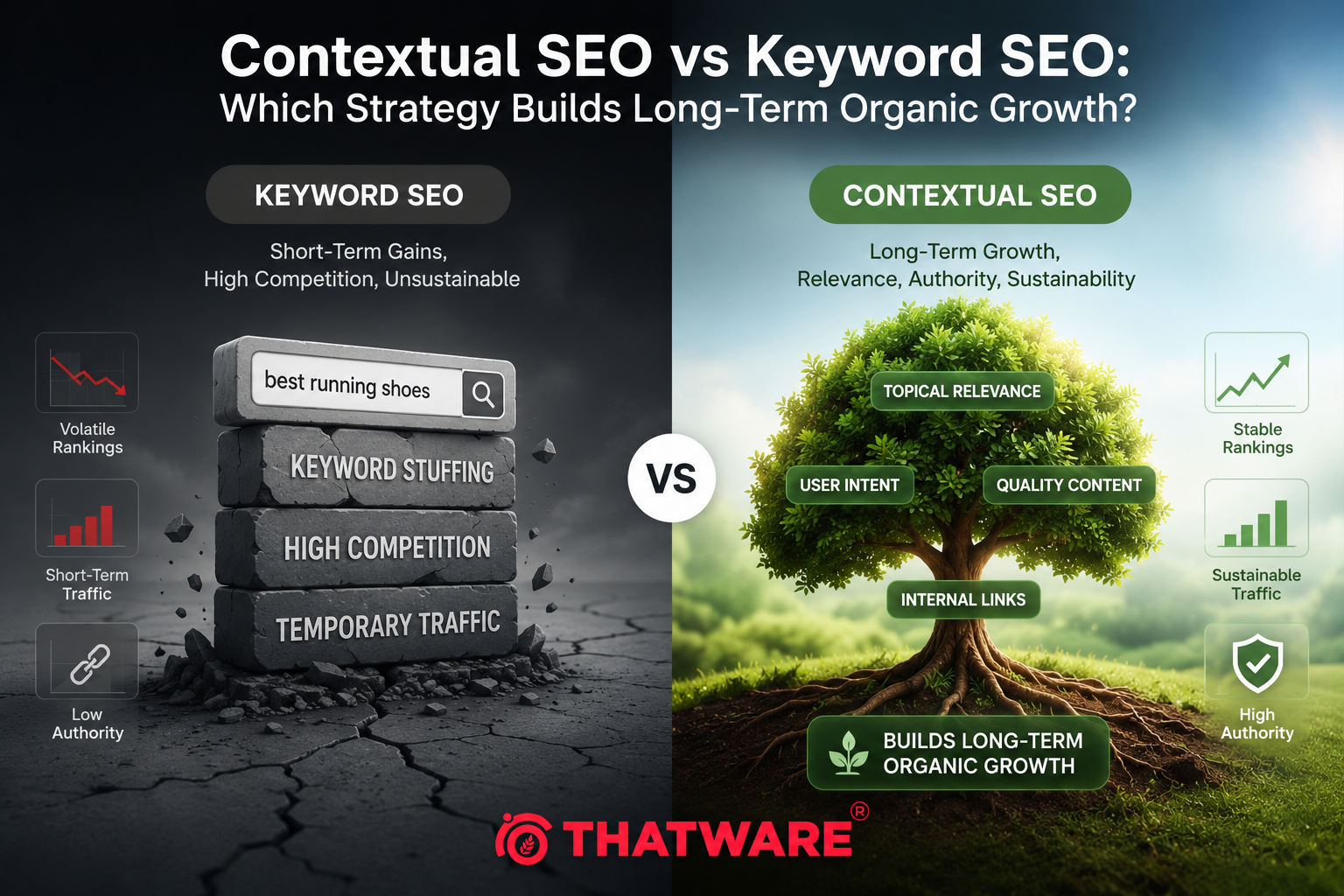
Discover how shifting from keyword matching to entity-based semantic search alters long-term traffic sustainability. Learn why leading digital growth agencies like ThatWare LLP champion topical authority over old-school keyword targeting to build bulletproof search visibility that survives major algorithm updates.
Entity SEO vs. Traditional Keyword SEO: The True Engine of Sustainable Search Growth
In the evolving landscape of organic search, SEO professionals often find themselves at a crossroads between two core methodologies: traditional keyword SEO and entity-based (or contextual) SEO. While some dismiss this as mere marketing jargon, the operational differences between the two dictate not just how you rank today, but whether you will continue to rank three years from now.
Both methodologies can drive traffic. However, when evaluating the lifetime value of your content investment, the question shifts from “How do we get traffic fast?” to “How do we build traffic that lasts?”
The Reality of Traditional Keyword SEO
Traditional keyword SEO is built on a straightforward premise: find a search term with viable volume and low competition, then create a page optimized to match that specific phrase.
This transactional approach has fueled the growth of countless websites. It is highly measurable, relatively quick to execute, and delivers clear, predictable short-term wins. If you need to demonstrate immediate traction or capture traffic for a seasonal product, keyword targeting is highly effective.
The problem, however, is the shelf-life. Keyword-centric content is inherently fragile. Because it relies heavily on surface-level optimizations (like exact-match phrases in headings and meta tags), it is incredibly easy for competitors to reverse-engineer and replicate. When a competitor publishes a longer piece or builds more backlinks to a similar keyword, your rankings slip. Maintaining a keyword-only strategy requires a relentless, expensive treadmill of content updates, re-optimization, and continuous link-building just to defend your existing real estate.
The Architecture of Entity-Based SEO
Entity SEO approaches the search landscape from the perspective of modern, AI-driven search engines. Instead of viewing a webpage as a collection of text strings, it treats concepts, brands, places, and ideas as distinct "entities" connected by a web of semantic relationships.
When you optimize for entities and topical context, your goal isn't to rank for a single phrase; it is to establish your brand as the definitive, unambiguous authority on a macro-topic. This involves deep topic clustering, addressing secondary and tertiary user intents, and mapping out content that answers the logical next questions a user might have.
This approach inherently changes the value of your content:
-
Smarter Internal Architecture: Pages are woven together logically, passing contextual relevance and authority throughout your entire ecosystem rather than forcing individual pages to compete against one another.
-
Algorithmic Resilience: Search engines evaluate the holistic depth of your website. When core algorithm updates roll out to reward true expertise, entity-optimized sites are typically lifted, while thin, keyword-stuffed sites lose visibility.
-
Broader Keyword Capture: A single, contextually rich page can rank for thousands of long-tail, semantic variations that you never explicitly targeted, because search engines understand the underlying concept of the page.
Compounding Growth vs. The Treadmill: The Traffic Lifecycle
The operational differences between these two strategies become vividly apparent when looking at their respective traffic lifecycles.
A traditional keyword approach yields a linear, spike-and-decay curve. You publish, you rank, you get a rush of traffic. But as the content ages and competitors enter the fray, that traffic inevitably decays unless you constantly inject more budget into content refreshes.
An entity-based approach yields a compounding, exponential curve. The initial growth is undeniably slower—often taking several months to gain traction as search engines map your site’s topical boundaries and validate your authority. However, once that threshold is crossed, the growth accelerates. Because your authority is rooted in a dense network of interconnected content rather than isolated pages, your search footprint becomes highly stable and deeply defensible.
The Strategic Verdict
Choosing between traditional keyword SEO and entity-based contextual SEO comes down to your brand's timeline and long-term objectives.
If your business model requires instant visibility or has a short runway, keyword SEO remains a necessary tool. But if you are investing for the future—building a digital asset that acts as a moat against competition—the shift to contextual and semantic search is non-negotiable. True search durability belongs to the brands that choose to own entire topics, not just search terms.
Kategorien
- Lifestyle
- Motivation
- News & Trends
- AI
- Gadgets & Reviews
- Tech News
- Marketing
- Ausbildung
- Health & Fitness
- Travel
- Food & Cooking
- Entertainment
- Home & Living
- Sports
- Art
- Causes
- Crafts
- Dance
- Drinks
- Film
- Fitness
- Food
- Spiele
- Gardening
- Health
- Startseite
- Literature
- Music
- Networking
- Andere
- Party
- Religion
- Shopping
- Sports
Mehr lesen
Introduction Eyelash extensions have become a popular beauty treatment for those who want fuller, longer, and more defined lashes without the hassle of daily makeup. In Carindale, this trend continues to grow as more people seek convenient ways to enhance their natural beauty. Whether you’re preparing for a special event or simply want to look polished every day, eyelash extensions...

Booking a luxury cruise vacation becomes easier when you understand how the reservation process works. Celebrity Cruises Reservations allow travelers to choose from premium cruise destinations, modern ships, luxury accommodations, and exclusive onboard experiences. Whether you are planning a family vacation, romantic getaway, or solo cruise adventure, knowing how to reserve your...

Discover the Excellence of Vietnamese Oud Oil In the world of luxury perfumery, few ingredients command as much respect and admiration as oud oil. Known for its deep, rich, and captivating aroma, oud has become a signature component in high-end fragrances, cosmetics, and wellness products. Choosing the right oud oil manufacturer is essential for brands seeking authenticity, consistency, and...

Choosing a meaningful gift for your son is never just about the item—it’s about the emotion, memory, and connection behind it. A bracelet, simple as it may seem, can carry deep sentimental value when chosen thoughtfully. Whether it’s for a birthday, graduation, or a moment of encouragement, selecting the right Bracelet For Son requires a balance of style, purpose, and...

If you are looking for reliable protection against hurricanes and severe weather, choosing the right Impact Windows and Doors in Miami is one of the smartest investments you can make. Designed to withstand high winds, flying debris, and heavy rain, these systems provide both safety and long-term value for your home. Whether you are upgrading an older property or building a new one,...