


Used Suzuki Car Drivetrain What Buyers Must Know First
Introduction
The drivetrain is the unsung backbone of any vehicle. It's not the engine that gets all the attention at the salvage yard, and it's rarely the first thing buyers think about when searching for used parts. But when a Suzuki drivetrain fails, the consequences are immediate and expensive. Whether you're restoring a Grand Vitara, rebuilding a Jimny, or patching up an Equator, buying a used Suzuki car drivetrain is a decision that deserves more scrutiny than most buyers give it. This article explores the full picture — the problems you'll encounter, the compatibility traps to avoid, and the year-specific details that matter.
Problems with Used Suzuki Drivetrains
The used drivetrain market for Suzuki vehicles carries some specific challenges that buyers should understand before starting their search:
- Limited Donor Vehicle Supply: Suzuki exited the US passenger car market in 2012. This means the pool of donor vehicles shrinks every year, directly affecting used part availability and pricing.
- Rust and Corrosion: Many Suzuki SUVs, particularly Jimny and SJ-series models, were used in off-road environments. Drivetrain components from these vehicles often show corrosion on axle housings, driveshaft flanges, and transfer case mounts.
- Unknown Mileage History: With no centralized database for Suzuki drivetrain-specific service records, verifying maintenance history is harder than with domestic brands.
- Transfer Case Wear: Suzuki's part-time 4WD transfer cases, used in the Vitara and Grand Vitara, wear unevenly when they've been operated incorrectly — frequently engaging 4WD on dry pavement causes internal binding damage.
- Differential Fluid Neglect: A common issue across the used market. Differentials that haven't had regular fluid changes develop scoring and pitting on the ring and pinion gears.
Key Points
- Always request the source vehicle's mileage and usage history before committing to a purchase.
- Physically inspect the driveshaft for u-joint play, rust pitting, and yoke condition.
- Check the transfer case for smooth mode switching — grinding or resistance indicates internal wear.
- Smell the differential fluid if accessible. A burnt odor suggests overheating from low fluid or overloading.
- Confirm whether the drivetrain is from an AWD or part-time 4WD variant — these are not interchangeable.
Compatibility
Suzuki used several different drivetrain configurations depending on the model and market year:
- SJ/Samurai Series: Older, simpler solid-axle setups. Wide aftermarket support but aging components.
- Vitara/Grand Vitara (2005): Independent front suspension with a chain-driven transfer case. Very different from the earlier solid-axle designs.
- Grand Vitara (2006–2013): Revised all-wheel-drive system. Front and rear differentials changed significantly from the previous generation — parts are not backward compatible.
- Equator (2009–2012): This is a rebadged Nissan Frontier. Drivetrain components are Nissan-sourced and follow Nissan compatibility rules.
Never assume a drivetrain from one Suzuki generation fits another without cross-referencing part numbers.
Year-Related Considerations
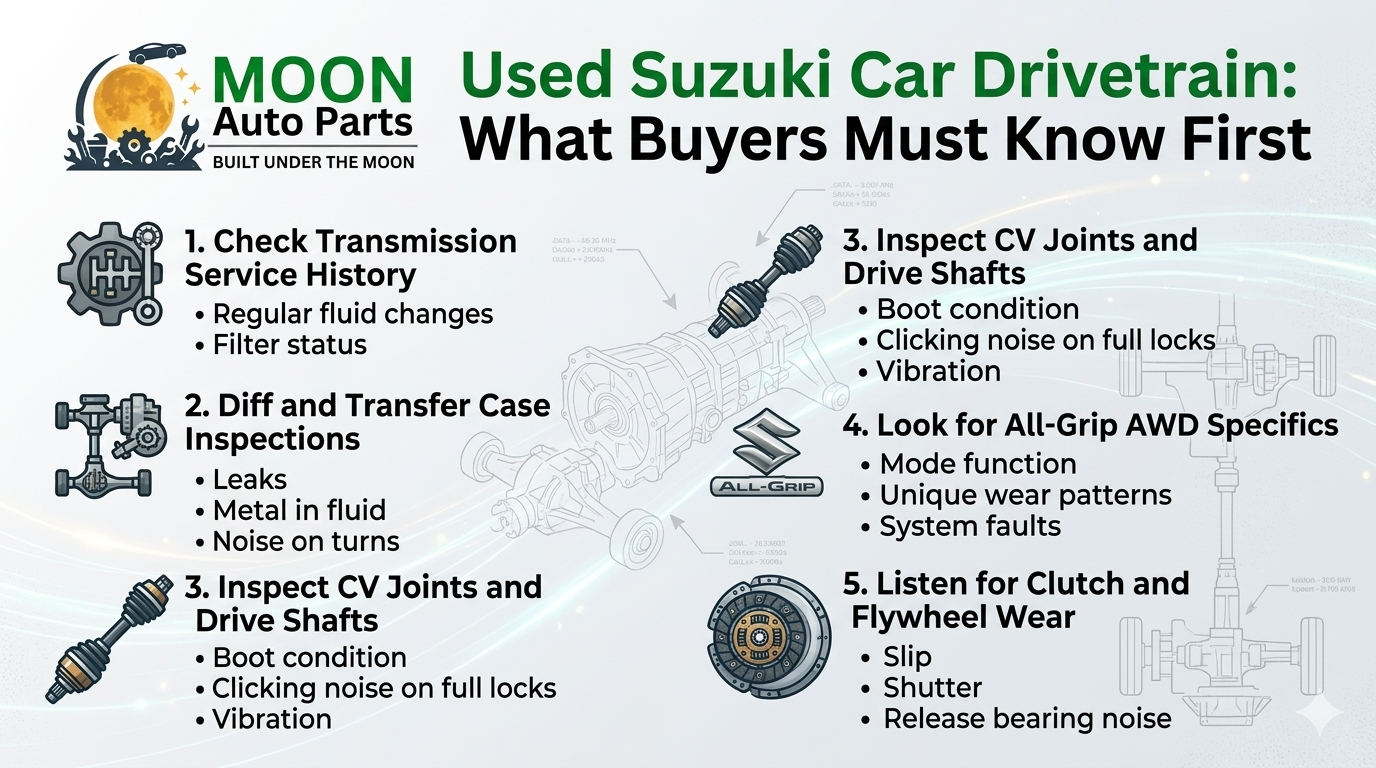
- Pre-1995 Models: Mechanically straightforward, but component fatigue is a real concern at this age. Inspect u-joints, CV boots, and axle seals carefully.
- 2005: Transition period with mix of older and newer drivetrain designs. Vitara models in this window are the most commonly available in the used market.
- 2006–2012: The final generation of US-market Suzukis. Availability is declining. These drivetrains are more modern but harder to source.
- Post-2012: No new US-market Suzukis, so used parts come exclusively from pre-owned vehicles that are now 12+ years old.
Conclusion
A used Suzuki car drivetrain can be a cost-effective repair solution, but only when the buyer does the investigative work upfront. Confirm the generation, verify the configuration, inspect physical condition, and account for the shrinking supply reality of a brand that no longer sells in your market. Patience and specificity are your two best tools.
FAQ
Q: Are Suzuki drivetrains interchangeable with any other brand?
The Equator's drivetrain is Nissan-compatible. Other Suzuki models are largely unique with limited cross-brand interchangeability.
Q: How do I identify which drivetrain variant I have? A: Check the VIN decode and the transfer case tag. Both carry model-specific identifiers that correspond to parts databases.
Q: What is the typical price range for a used Suzuki drivetrain assembly?
Prices vary widely, but expect limited supply to push prices above what comparable domestic-brand parts cost.
Q: Can I convert a 2WD Suzuki to 4WD using a used drivetrain?
In theory, yes — but this is a complex conversion requiring frame modifications, ECU changes, and significant labor. Not a straightforward swap.
Q: Where is the best place to find used Suzuki drivetrain parts in the US?
Specialty Suzuki salvage dealers, online auto recycler networks, and Suzuki-specific enthusiast forums are the most reliable sources.
Read more - Used Ford F-150 for Sale A Data-Driven Buyer's Checklist
Κατηγορίες
- Lifestyle
- Motivation
- News & Trends
- AI
- Gadgets & Reviews
- Tech News
- Marketing
- Εκπαίδευση
- Health & Fitness
- Travel
- Food & Cooking
- Entertainment
- Home & Living
- Sports
- Art
- Causes
- Crafts
- Dance
- Drinks
- Film
- Fitness
- Food
- Παιχνίδια
- Gardening
- Health
- Κεντρική Σελίδα
- Literature
- Music
- Networking
- άλλο
- Party
- Religion
- Shopping
- Sports
Διαβάζω περισσότερα
The world of online betting has evolved rapidly, and slot games are leading the way. What once required a visit to a physical casino can now be experienced instantly on a smartphone. With better graphics, smoother gameplay, and bigger rewards, online slots and betting platforms are attracting players from all over the world. The Digital Shift in Betting In recent years, betting has shifted...

Summer in Meerut brings intense heat, bright sunlight, and rising indoor temperatures that can make homes feel uncomfortable. During this season, the right interior choices can completely transform your living space into a cool, refreshing, and relaxing environment. From selecting breathable curtains to choosing light wall colors and heat-friendly furniture, every design decision matters. If...

Thyroid: Causes, Symptoms, and Treatment The thyroid is a small but powerful gland that plays a crucial role in regulating metabolism and overall body function. Even though it is tiny in size, its impact on health is significant. Any imbalance in thyroid hormone levels can affect energy, weight, mood, and many vital processes in the body. Understanding how the thyroid works, along with its...

In today’s competitive business environment, companies that rely on vehicles need complete visibility, control, and efficiency to stay ahead. Rising fuel costs, increasing traffic congestion, and growing customer expectations make fleet operations more complex than ever. This is where GPS tracking software plays a critical role. By providing live location data, actionable...

Bearing the burden of never-ending to-do lists, sore muscles after a gym-visit, or of dry skin after the chilly air of Langley? Consider sinking into a treatment that would ting the stress, iron out the cellulite and make your skin as tender as butter–sufficient to hike the trails in Derby Reach or to evenings idle on Walnut Grove. Divine Skin Therapy situated in Langley offers luxurious...
