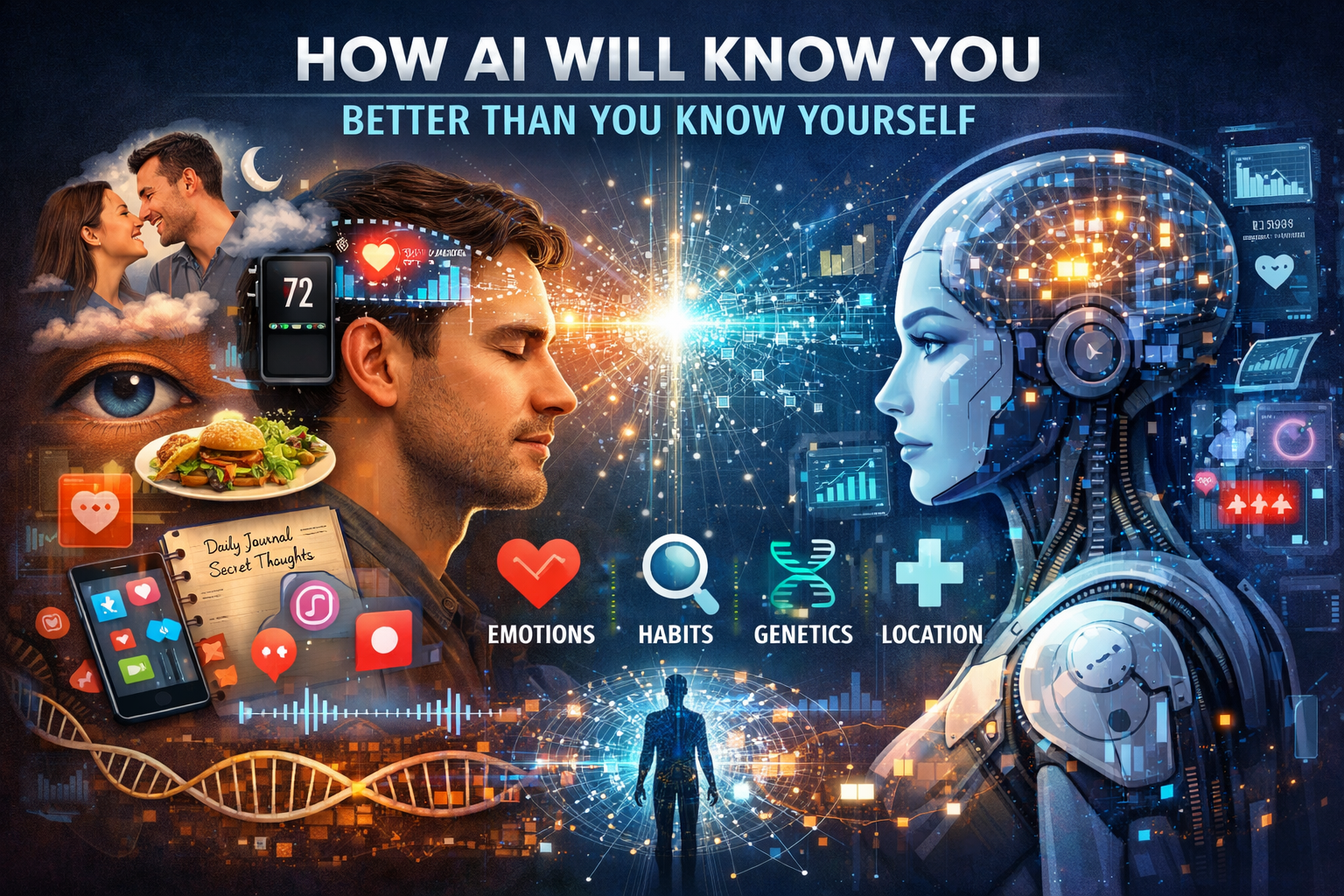
Artificial Intelligence (AI) has moved far beyond its initial hype. It has permeated every aspect of our lives, from healthcare and education to entertainment and customer service. We often hear that AI is reshaping industries and revolutionizing our world, but one of the most fascinating—and, at times, unsettling—aspects of AI is its potential to understand us in ways we never thought possible. With advancements in data analysis, machine learning, and neural networks, AI is now on the verge of knowing us better than we know ourselves.
In this blog post, we’ll explore how AI is poised to understand our behaviors, preferences, and emotions on a deeply personal level. From analyzing our online activity to recognizing our mood shifts, AI is steadily learning more about us, and this could soon lead to a future where AI anticipates our needs, desires, and even our emotional state before we’re aware of them. Let’s dive into how AI will know you better than you know yourself.
The Power of Data
At the heart of AI's ability to understand you lies data. You might be wondering, how does AI know so much about us? The answer is simple: we are constantly generating vast amounts of data. Whether it's our search history on Google, the music we listen to on Spotify, the shows we binge-watch on Netflix, or even our fitness activities tracked by apps like Strava, we are creating a digital footprint wherever we go.
AI thrives on this data. By analyzing patterns and trends in our behavior, AI algorithms can build detailed profiles of who we are, what we like, what we need, and how we make decisions. The more data AI collects, the more accurate its predictions become. Over time, AI can begin to predict our future actions and preferences with astonishing accuracy.
For example, have you ever noticed how your YouTube or Netflix recommendations seem to know exactly what you want to watch next? These platforms leverage AI to analyze your viewing habits, preferences, and even the time of day you’re most likely to watch certain types of content. As AI continues to gather data, its ability to make recommendations becomes increasingly personal. In the future, AI could know what kind of content, food, or even experiences you’ll crave before you even realize it.
Personalized Recommendations: From Products to Experiences
We are all familiar with personalized recommendations by now. Whether you’re scrolling through social media or shopping online, algorithms seem to have an uncanny knack for suggesting products that align with your interests. But this is just the tip of the iceberg.
AI is starting to personalize experiences in a much deeper way, making it capable of predicting your needs before you voice them. Take, for example, virtual assistants like Siri, Alexa, or Google Assistant. These AI-driven systems are becoming increasingly adept at understanding not just your requests but also your preferences, routines, and even your mood.
Imagine a world where your virtual assistant knows exactly when you’re feeling down and plays your favorite upbeat playlist to lift your spirits. Or a system that, based on your daily habits, suggests a new book or a workout routine that you’d love—without you ever having to ask. In this world, AI doesn’t just react to your commands; it anticipates your needs, sometimes even before you’re consciously aware of them.
Behavioral Insights and Predictions
AI doesn’t just rely on basic data like what you purchase or what you search for online; it is now capable of analyzing your behavior in real-time. This includes tracking micro-expressions, facial cues, body language, and even vocal tones to understand your emotional state.
Some companies have begun integrating AI systems into customer service, using facial recognition and sentiment analysis to gauge whether a person is frustrated, happy, or neutral during a conversation. In the future, such technologies could be employed in every aspect of life, from personal relationships to shopping experiences. For example, imagine if your AI assistant could detect when you’re feeling anxious based on subtle changes in your voice and then recommend a meditation app or adjust the lighting and music in your home to help you relax.
AI’s ability to understand our emotions is an essential piece of this puzzle. Emotional intelligence has long been considered a uniquely human trait, but with advancements in AI’s ability to recognize and respond to emotional cues, it’s no longer a distant concept. In fact, AI is already being trained to understand complex human emotions, which is a major step toward it knowing us better than we know ourselves.
Predicting Your Future Behavior
One of the most powerful aspects of AI is its ability to predict future behavior based on historical data. If AI has enough data on your habits, preferences, and emotions, it can predict with impressive accuracy what you’ll do next.
Take, for example, predictive analytics in marketing. AI analyzes your online shopping behavior, purchase history, and browsing habits to predict what you’re likely to buy next. This technology is already being used by retailers like Amazon, where the system can suggest products based on your past purchases and even what similar customers are buying. In fact, some AI systems are so advanced that they can predict the likelihood of a customer making a purchase at a specific time or on a particular day.
But the potential for prediction goes beyond retail. In healthcare, for instance, AI can analyze your medical history, genetic information, and lifestyle factors to predict your risk of developing certain conditions. It might even suggest preventative measures before you experience any symptoms.
AI is also moving into the realm of mental health. By analyzing patterns in your behavior, sleep patterns, or social media activity, AI can potentially predict when you might experience a mood shift or a mental health issue like depression or anxiety. With such insights, AI could offer interventions or guidance before you even realize you’re struggling.
AI’s Role in Personal Relationships
Perhaps the most thought-provoking aspect of AI’s future role in our lives is its potential to understand us on a deeply personal level—perhaps even better than our closest friends and family. As AI systems become more advanced, they could not only predict our behavior but also understand our desires, fears, and motivations in ways that our loved ones may not.
Think about AI’s ability to track your communication style, your preferences in relationships, and the dynamics of your interactions. It could predict when you're about to have an argument or when you need emotional support. Imagine if your AI assistant could step in to mediate a conversation, suggesting ways to approach sensitive topics or even helping to diffuse tension before it escalates.
Such AI could also help improve self-awareness. For example, if AI notices that you tend to make certain choices that are not in your best interest, it might offer reminders or suggestions to guide you toward better decisions. Over time, these insights could lead to increased self-understanding and personal growth.
The Ethical Dilemmas
While the idea of AI knowing us better than we know ourselves is both fascinating and promising, it also raises significant ethical concerns. One of the primary issues is privacy. The more data AI collects about us, the greater the risk of that information being misused. Could AI’s knowledge of our preferences and emotions be used to manipulate us? What happens if AI knows us so well that it can predict when we’re most vulnerable to targeted advertising or other forms of persuasion?
Another concern is the potential for AI to reinforce biases. If AI systems are only trained on data from certain groups of people or communities, they may fail to understand or accurately predict the behaviors and needs of other groups. This could lead to the marginalization of certain individuals or communities, further entrenching existing inequalities.
Lastly, there is the question of autonomy. If AI knows us better than we know ourselves, will we lose control over our own decisions? Will we begin to rely too heavily on AI to make decisions for us, from small choices like what to eat to more significant decisions like career moves or personal relationships?
The Future of AI and Human Understanding
Despite the challenges and ethical concerns, the future of AI is undeniably fascinating. As AI continues to evolve and grow more sophisticated, it will have the potential to understand us in ways we never imagined. From personalized recommendations to behavioral predictions and emotional insights, AI is poised to be an indispensable part of our lives.
However, as we move forward, it is essential that we remain vigilant about the ethical implications of AI and ensure that its power is used responsibly. By striking a balance between innovation and ethics, we can ensure that AI serves to enhance our lives and helps us understand ourselves in deeper and more meaningful ways.
In the coming years, AI may indeed know you better than you know yourself—but whether that’s a good thing or not depends on how we choose to harness this powerful technology. The question remains: will we be able to control AI, or will AI ultimately control us?
As we embrace this new era of AI, one thing is certain: the journey ahead will be both exciting and full of surprises, as we continue to push the boundaries of what AI can do and how it can reshape our understanding of ourselves.


 English
 Arabic
 French
 Spanish
 Deutsch
 Turkish
 Dutch
Dutch
 Italiano
 Russian
 Romaian
 Portuguese (Brazil)
 Greek
Greek