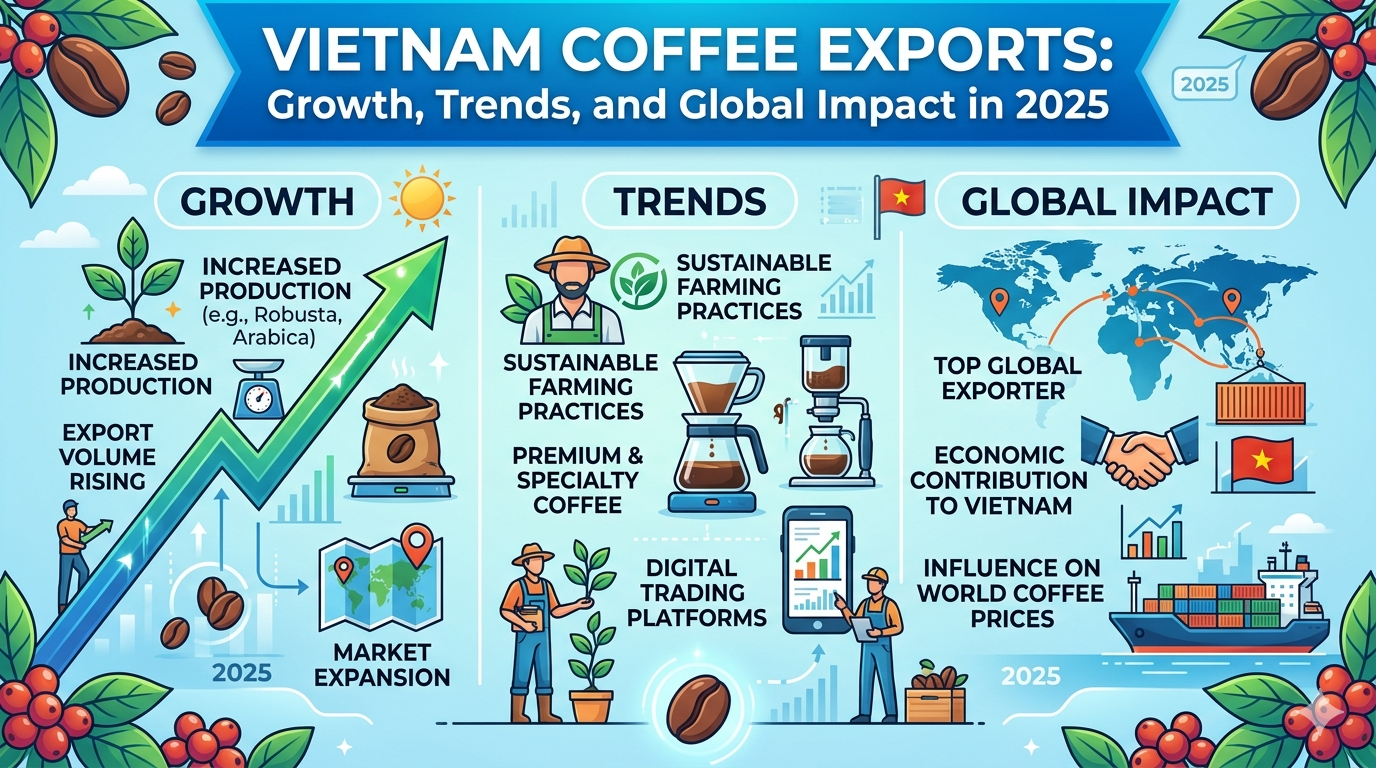
Vietnam has firmly established itself as a powerhouse in the global coffee industry. Over the past decade, the country has significantly expanded its production capacity, strengthened trade relationships, and improved export value. Today, Vietnam coffee exports are among the most influential in shaping global coffee trade dynamics, positioning the country as the second-largest coffee exporter worldwide.
Driven by favorable climatic conditions, a robust supply chain, and increasing global demand, Vietnam’s coffee sector continues to break records. According to recent Vietnam customs data, the country achieved remarkable export performance in 2024 and is on track for even greater milestones in 2025.
Record-Breaking Growth in Vietnam Coffee Exports
The year 2024 marked a historic milestone, with Vietnam coffee exports reaching approximately $5.62 billion, reflecting a 12% increase from the previous year. Despite a drop in export volume due to lower production, export value surged significantly due to rising global coffee prices.
Between January and mid-December 2024, Vietnam exported around 1.26 million tons of coffee, generating about $5.2 billion in revenue. While export volumes declined by 16.5%, export value increased by 32.4%, highlighting the impact of premium pricing.
This trend continued into 2025. In the first quarter alone, export revenues exceeded $2.8 billion, supported by an average export price of $5,614 per metric ton. Such growth underscores the resilience and adaptability of Vietnam coffee exporters in navigating global market fluctuations.
Vietnam Coffee Exports in 2025: A Strong Outlook
The outlook for 2025 remains highly optimistic. Industry projections suggest that Vietnam coffee exports could reach a total value of $7 billion by the end of the year.
Key highlights from early 2025 include:
- Export revenue of $4.7 billion in the first five months
- Nearly 149,000 tons exported in May alone
- Export value growth of over 60% year-on-year
- Average export prices rising to $5,709 per ton
Despite slight fluctuations in volume, the overall upward trajectory in export value reflects strong global demand and improved pricing power. This growth has further strengthened Vietnam’s position in global vietnam exports, especially within the agricultural sector.
Major Markets Driving Vietnam Coffee Exports
Global demand for Vietnamese coffee continues to rise, with key markets playing a critical role in sustaining export growth.
Top Importing Countries:
- Germany – Largest importer with $705 million
- United States – $610 million in imports
- Italy – Strong demand from coffee culture hubs
- Japan & Spain – Growing appreciation for Vietnamese coffee
- Belgium & Russia – Emerging strong markets
The European Union remains the largest regional market, importing over 367,000 tons valued at $2 billion. Meanwhile, exports to the United States have also grown significantly, supported by increasing consumer interest in affordable and high-quality coffee.
These trends demonstrate how Vietnam coffee exports are diversifying across regions, reducing dependency on a single market and ensuring long-term sustainability.
Vietnam Coffee Production: Backbone of Export Success
A key factor behind export success is strong Vietnam coffee production. The country produces approximately 1.74 million tons of coffee annually, making it the second-largest producer globally after Brazil.
Key Production Insights:
- 96% Robusta coffee, known for strong flavor
- 4% Arabica coffee, catering to premium markets
- Cultivation spread across 30+ provinces
- Major regions: Dak Lak, Lam Dong, Gia Lai
Vietnam’s dominance in Robusta production is particularly noteworthy. In recent years, Robusta prices have even surpassed Arabica in global markets, boosting export revenues significantly.
The role of smallholder farmers is also crucial, as they form the backbone of vietnam coffee production, ensuring consistent supply and quality.
Price Trends and Market Dynamics
One of the most defining aspects of recent growth in Vietnam coffee exports is the sharp increase in prices.
- Average export price (2023–24): $3,792/ton
- Early 2025 prices: $5,630/ton
- Domestic prices: $5.4–$5.6/kg
These rising prices are driven by global supply shortages, climate challenges, and increased demand. Farmers are increasingly holding back stock in anticipation of further price hikes, impacting short-term supply but boosting long-term profitability.
Additionally, there is a noticeable shift toward value-added products such as roasted and soluble coffee, which now account for a growing share of exports.
Leading Vietnam Coffee Exporters
The success of Vietnam coffee exporters is driven by a mix of domestic companies and multinational players. These companies play a vital role in connecting Vietnamese coffee to global markets.
Top Exporters Include:
- Intimex Group
- Vinh Hiep Co., Ltd
- Louis Dreyfus Vietnam
- Nestlé Vietnam
- Olam Vietnam
- Simexco Daklak
These Vietnam coffee exporters are known for their large-scale operations, strong global networks, and commitment to quality. Their strategic partnerships with international buyers have helped expand Vietnam’s presence in key markets.
As global demand continues to grow, these exporters are expected to focus more on sustainability, traceability, and premium product offerings.
Historical Growth of Vietnam Coffee Exports
Over the past decade, Vietnam coffee exports have shown remarkable resilience and growth:
- 2014: $3.31 billion
- 2019: $2.21 billion
- 2020: $1.97 billion (pandemic impact)
- 2023: $3.18 billion
- 2024: $5.62 billion
This steady upward trend highlights the increasing importance of coffee within overall vietnam exports, making it one of the top agricultural commodities alongside rice and fruits.
Challenges and Trade Barriers
Despite strong growth, the industry faces several challenges:
1. Tariff Pressures
The United States imposed a 46% tariff on Vietnamese Robusta coffee in 2025, impacting competitiveness in that market.
2. Climate Risks
Drought conditions in 2023–24 reduced output by 20%, highlighting vulnerability to weather fluctuations.
3. Supply Chain Adjustments
Delays in sales and stock hoarding by farmers require buyers to adopt more flexible contracts.
However, access to markets through agreements like ASEAN-India FTA offers new opportunities, allowing tariff-free entry into emerging markets.
Future Outlook for Vietnam Coffee Industry
The future of Vietnam coffee exports looks highly promising. Production is expected to recover, with output projected to increase by 17% in the 2025–26 season.
Key Growth Drivers:
- Expansion into Asian markets
- Increased demand for processed coffee
- Rising global coffee consumption
- Strategic trade diversification
The integration of advanced farming techniques and improved supply chain management will further enhance Vietnam coffee production, ensuring long-term sustainability.
Key Takeaways for Businesses
For stakeholders, including traders and buyers, several strategic insights emerge:
- Diversify sourcing markets to reduce risk
- Focus on value-added coffee products
- Monitor Vietnam customs data for market trends
- Leverage trade agreements for cost advantages
- Build flexible contracts to adapt to supply shifts
By aligning strategies with these trends, businesses can capitalize on the continued growth of vietnam coffee exports.
Conclusion
Vietnam’s coffee industry is entering a new era of growth and global influence. With rising prices, expanding markets, and strong production capabilities, Vietnam coffee exports are set to remain a dominant force in international trade.
The country’s ability to adapt to market changes, invest in quality, and strengthen trade partnerships ensures sustained success. As demand for coffee continues to rise worldwide, Vietnam coffee exporters are well-positioned to meet global needs while driving economic growth.
Backed by reliable Vietnam customs data and evolving trade strategies, Vietnam’s coffee sector is not just growing—it is redefining the global coffee landscape.